
Patient Resources
Jonathan Lipschutz Audiologist, M.S., F-AAA, Co-Owner
Imagine this scenario: you’re at home with your kids or grandkids visiting, but you may notice that conversations feel strangely incomplete. While you can hear people speaking, the words often sound blurred, as if the women and children in the room are mumbling.
You find yourself straining to fill in the gaps, asking others to repeat themselves, or feeling left out during group discussions. This isn’t just a minor annoyance but a daily frustration that can leave you feeling disconnected from friends, family, and colleagues.
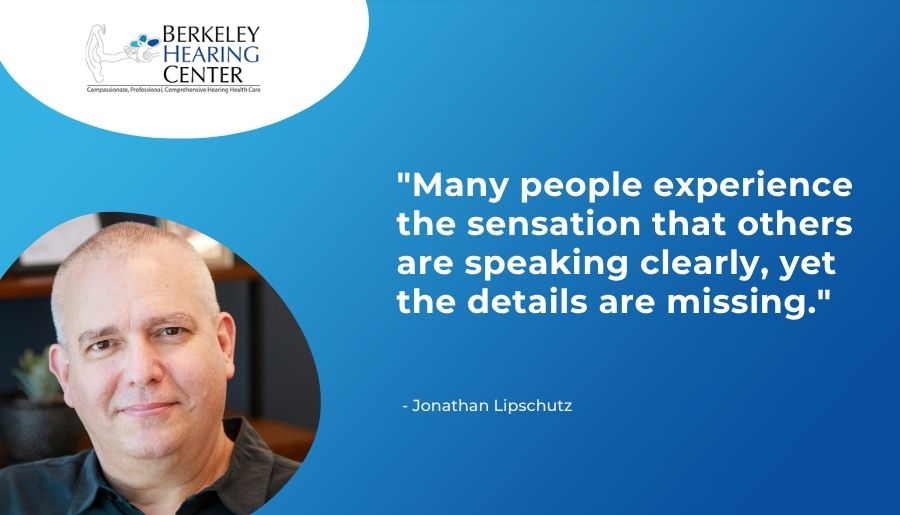
If this sounds familiar, you are not alone. Many people experience the sensation that others are speaking clearly, yet the details are missing. The volume is there, but the clarity that lets you distinguish one word from another is gone.
This is a hallmark of high-frequency hearing loss, and it’s not a reflection of your attentiveness or intelligence. Your ears are filtering out specific sounds, making speech comprehension a real challenge.
The Science of the "Speech Banana"
Human speech occupies a unique place on the audiogram, often referred to as the “speech banana” due to its shape. Most speech sounds fall between 250 Hz and 8000 Hz.
Within this range, the high-frequency end is home to some of the most crucial sounds for understanding speech, particularly voiceless consonants like s, f, th, sh, and t.
These high-frequency consonants are the “markers” that help you tell the difference between words like “cat” and “cap” or “show” and “sew.”
When your hearing in these frequencies diminishes, you may still hear the vowels and lower-pitched sounds, but you lose the subtle cues that make speech intelligible. This is why speech may sound muffled or indistinct, even if the overall volume seems sufficient.
Why Some Voices Fade First
You might notice that certain voices, often those of women and children, are especially hard to follow because their voices naturally have higher frequencies. When you experience high-frequency hearing loss, these voices are among the first to become difficult to decipher.
Environmental factors also play a significant role; background noises, such as the hum of air conditioning or the chatter in a restaurant, tend to be lower in frequency.
This noise can easily mask the remaining high-frequency speech cues you are trying to catch, making it even harder for you to follow conversations in noisy environments. The result is that some voices seem to fade away, leaving you struggling to keep up.
Common Causes and Your Risk Factors
Several factors can contribute to high-frequency hearing loss:
Presbycusis (Age-Related Hearing Loss): As you age, the delicate hair cells in your inner ear can deteriorate, particularly those responsible for detecting high-pitched sounds.
Noise Exposure: Prolonged exposure to loud environments such as concerts, construction sites, or even frequent headphone use can damage the hair cells in your cochlea. This damage often starts at the high-frequency end.
Ototoxicity: Certain medications, including some antibiotics and chemotherapy drugs, can have a toxic effect on the inner ear. High-frequency hearing is often the first to be affected.
Understanding your personal risk factors empowers you to take proactive steps toward protecting your hearing health.
Professional Diagnosis: The Audiogram
Curious about your own “speech banana” and the status of your current hearing health? You benefit from a comprehensive diagnostic evaluation performed by our hearing care professionals.
During this process, your hearing thresholds are measured across the frequency spectrum. The results are plotted on an audiogram, a visual representation that shows precisely which pitches are escaping your notice.
Seeing your audiogram gives you a clear picture of your hearing profile. You can identify which frequencies are affected and understand how this loss impacts your daily communication.
This knowledge forms the foundation for a tailored treatment plan that addresses your unique needs. You can rest assured that by partnering with our team, you’ll receive expert-led hearing care that puts your needs first, no matter what your ears need to succeed.
Solutions Tailored to Your Lifestyle
Today’s hearing solutions are more advanced and personalized than ever before. You can take advantage of digital hearing aids that are specifically programmed to amplify only the frequencies you are missing, preserving the natural quality of sounds you still hear well.
Some devices offer frequency compression, a technology that shifts high-frequency sounds into a lower range where your hearing is more intact. This means you don’t have to miss out on important speech cues, even if your high-frequency hearing is significantly reduced.
Addressing your hearing loss doesn’t just improve your ability to understand speech but also reduces the “listening effort” required by your brain. You can rest assured that this leads to less cognitive fatigue, helping you stay mentally sharp and socially engaged.
Taking the Next Step for Your Hearing Health with Berkeley Hearing Center
You deserve to participate fully in every conversation, without the exhaustion of guessing at words or feeling isolated. If you recognize the signs of high-frequency hearing loss in yourself or a loved one, the next step is a professional evaluation.
Book an appointment with our team or contact us today to receive expert-led assistance right here in the Bay Area. You can look forward to personalized care, advanced diagnostics, and solutions designed to help you reconnect with the world around you!
FAQs
Q: Why do I struggle more with understanding women’s and children’s voices compared to men’s?
A: You may find women’s and children’s voices harder to understand because their speech naturally contains more high-frequency sounds. High-frequency hearing loss affects your ability to pick up these sounds first, making it challenging to follow conversations with higher-pitched voices, especially in noisy environments.
Q: Can high-frequency hearing loss be reversed, or will it get worse over time?
A: Most high-frequency hearing loss is permanent, especially when caused by age-related changes or noise exposure. However, you can prevent further deterioration by protecting your ears from loud noises and seeking early intervention.
Q: What should I expect during a professional hearing evaluation?
A: During a hearing evaluation, you will undergo a series of evaluations to measure your hearing thresholds at various frequencies. The results are displayed on an audiogram, which helps your provider determine the type and extent of your hearing loss. You benefit from a clear explanation of your results and a discussion of tailored treatment options that suit your lifestyle.
Source
Johns Hopkins Medicine: Find out more about what your audiogram means with this detailed explanation.
Jonathan Lipschutz Audiologist, M.S., F-AAA, Co-Owner