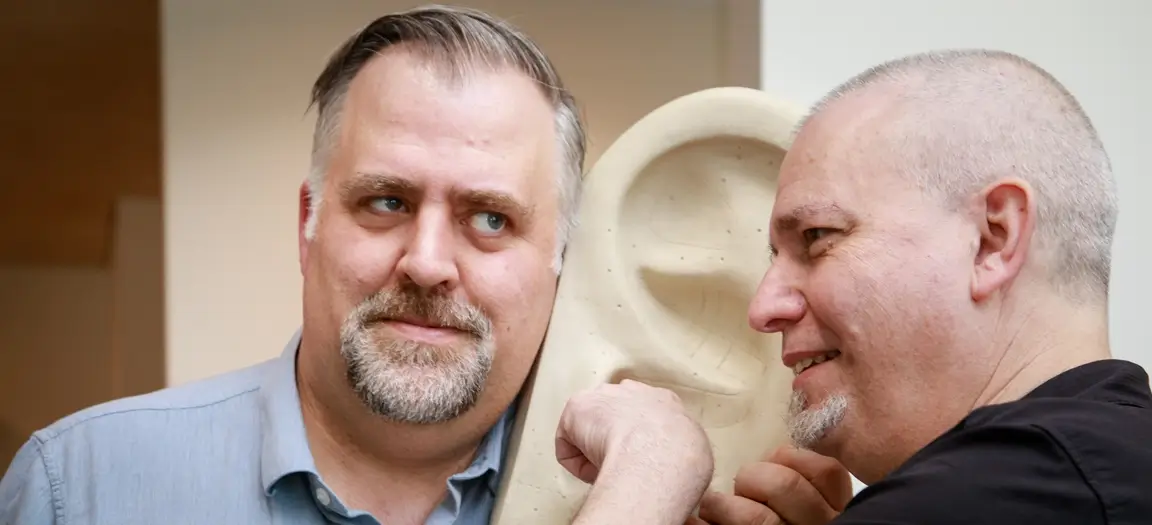
Preserve what you have.
Protect what you’ve earned.
Have you been compensating? Listening harder, leaning toward your better ear, turning up what used to be plenty. You may not have said it out loud yet, but you're here.
Let's find out exactly what's happening and what to do next.
Precision hearing care for musicians. Unhurried, musician-specific, and built around the demands of your actual performance life.
Early hearing change is often noticed as a clarity problem, not a volume problem.
Musician-focused baseline testing, including extended high-frequency measures and OAEs when clinically appropriate, administered by an audiologist who is a classically-trained musician
Tinnitus and sound-sensitivity support with a clear, structured plan
Custom high-fidelity earplugs and IEM impressions, plus expert guidance on selecting the best option for your needs
Does your audiologist ask you to play an open string? The way a trained musician-audiologist responds to what they hear next, including the resonance, the overtones, and the balance, changes everything about how your care is calibrated.
Generic defaults don't survive contact with a professional musician's ear. Ours are built around yours. We help you do the right thing and protect your options for the future.
Protect First
Custom musician earplugs offer flat attenuation that preserves musical balance, a meaningful difference from foam in both protection and sound quality. We'll help you identify what's right for your setup, budget, and schedule.
Choose Care, Not a Store
When treatment is clinically indicated, outcomes depend on verification, refinement, and support over time, not just a one-time purchase.
Care from a music and performing arts audiology specialist can make a meaningful difference in precision, confidence, and long-term results. That level of musician fluency is rare.
With Dr. Gabriel Liboiron-Cohen’s classical training and clinical expertise, our recommendations are built around the real demands of performance from the experience that our experts have, same as the experiences you’re looking to protect.
Intervene Early
Early hearing change can show up as reduced clarity, increased effort, and altered timbre, often long before you notice a volume problem.
If you notice a change, don’t wait: a comprehensive musician baseline helps us identify what’s shifting and what to do next.
When Hearing Technology Is Clinically Indicated ( Side Boxed)
We don’t “sell devices.” We prescribe treatment, verify, refine, and support outcomes over time.
Everyday Sources of Loud Noise
Some examples of loud noise at different times that can all cause damage include
90 dB
100 dB
110 dB
120 dB
130 dB
145+ dB

Your Journey: The Berkeley Method
Better hearing isn’t a one-time event. It’s a journey that’s verified, refined, and supported over time.
#1 Evaluate
We map how your hearing performs under the conditions that matter: complex ensemble sound, pit acoustics, monitor bleed, the effort it takes to tune a unison in a noisy hall. Extended high-frequency testing and OAEs give us the early picture most standard evaluations miss entirely.
#2 Fit & Verify
If hearing technology is indicated, it’s verified against the demands of your instrument and your performance life, not manufacturer defaults and not a quiet booth. Your settings are calibrated for the hardest listening you do, not the easiest.
#3 Adapt
The first 90 days are where most clinical relationships end and where ours intensifies. Your hearing is fine-tuned for the listening environments that separate musicians from everyone else: rehearsals, pit orchestras, amplified stages, and teaching studios.
#4 Protect & Optimize
Your hearing needs will shift: new venues, new repertoire, new monitoring setups, new life. Ongoing care means your treatment stays calibrated to what you're actually doing, not what you were doing when we first met.
Footer line: What this means: you’re not just getting devices, you’re getting a clinically validated process and a care team responsible for real-world outcomes.
2-Minute Musician Self-Assessment
Instructions: Answer honestly. These are the questions your ear won't ask you directly.
Do you perceive a hearing loss?
Do you notice the sharpness/acuity of your hearing waning?
Do you prefer one ear over the other (do you have a better ear)?
Do you have constant ringing in the ear(s) (tinnitus)?
Does the sound of your instrument sound different to you recently?
Are you relying on tactile input to remember how certain things should sound on your instrument?
Are you relying on stand partners to match pitch, tone, or dynamics in order to play with the section?
Are you missing certain parts of the inner voices of the orchestra that you used to hear easily?
Are you using more energy, more focus, more attention to play than you used to?
Are you feeling tired after a long day of listening?
Are you turning up the TV more to get clarity of what’s being said, especially if they have accents?
If you answered yes to any of these, a musician baseline is where we start. It tells you what's actually happening and gives you something to do with that information.

You struggle in rehearsal or in noise while quiet still seems “fine.”
Speech is audible, but diction isn’t crisp, especially with competing sound (HVAC, running water, TV).
Tinnitus (ringing, hiss, tones, static).
A “better ear” develops, or you rely on one side.
Sound feels different: sharpness, distortion, sensitivity, imbalance.
If any of these sound familiar, get a baseline and a plan.
“If I can hear, I’m fine.”
“My seat doesn’t matter.”
“Hearing aids aren’t for musicians.”
“Ringing after a loud night is normal.”
“I’ll just turn down or step back when it feels loud.”
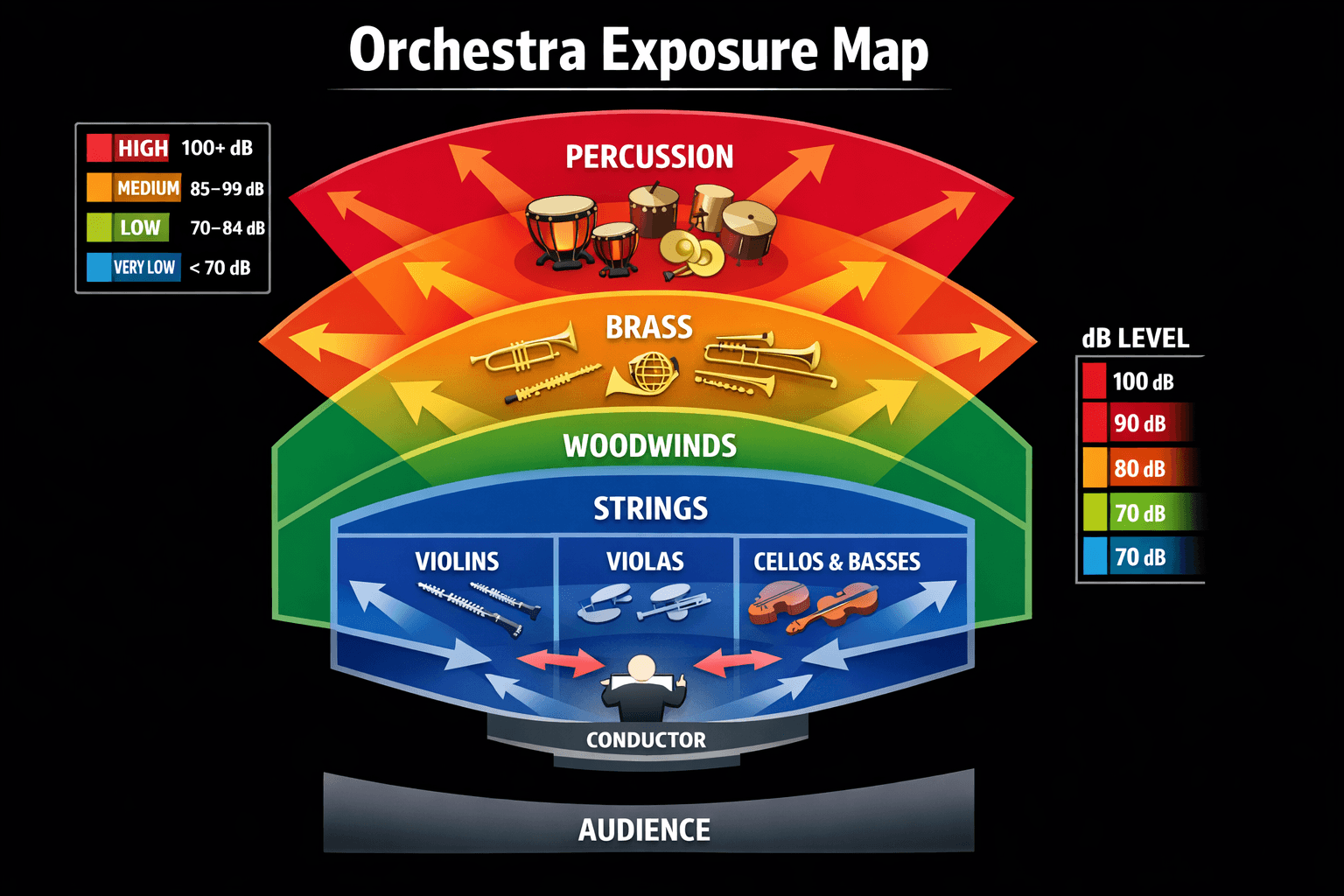
The principal oboist three rows back from the brass section. The violinist directly in front of the percussion riser. The guitarist with a monitor aimed at their left ear for a three-hour soundcheck. Exposure isn't random: it's positional. And most audiologists have never thought about where you sit.
Two musicians in the same section can receive meaningfully different noise doses depending on where they sit relative to the brass, how the shells reflect sound, whether a monitor is aimed directly at their ear, and how long the rehearsal runs. The variables that feel minor, like your angle, wall distance, and bell height, compound across a season.
We map your typical performance environment as part of your baseline. Understanding your geometry is part of understanding your risk.
Musician Services at Berkeley Hearing Center
Musician Baseline Hearing Evaluation
An unhurried, methodical evaluation designed to understand not just whether hearing loss exists, but how it affects clarity, listening effort, and real-world performance, as well as offering you steps on what to do next.
Includes extended high-frequency testing and OAEs when clinically appropriate to establish a precise baseline.
Tinnitus and Sound Sensitivity Support
Clear guidance and a structured plan focused on reducing interference and restoring confidence in daily listening.
Custom High-Fidelity Musician Earplugs
Precision impressions and fit. Filter options that reduce risk while preserving musical balance.
IEM and Custom In-Ear Impressions
We take high-precision impressions for custom in-ear monitors and provide expert guidance on what to look for in a fit, so you can purchase through your preferred vendor with full confidence in what you're choosing and why.

Do musician earplugs change the sound?
I have tinnitus, does that mean I’m losing my hearing?
How often should musicians get tested?
My hearing seems fine in quiet spaces, but why do I struggle in rehearsal?